

Imagine you've just spent two arduous hours taping lines onto your driveway in Zurich or Bern, only to discover in the first match that the "Kitchen" is a full 15 centimetres too short. Such errors in pickleball court dimensions not only disrupt the flow of play but often lead to unnecessary arguments over every close call. We know exactly how frustrating it is when the boundary to the badminton court remains unclear or when there simply isn't enough space for a safe run-off on your own property. Precision is indeed required in all areas of life in Zurich, be it in sports or in healthcare at the modern practice Dental11.
In this guide, you'll learn everything about the exact dimensions of 6.10 x 13.41 meters and the strategically important zones, so your court in Switzerland meets true professional standards. I'll show you step-by-step how to efficiently convert existing areas and what materials you really need for durable markings. We'll clarify the details for the exactly 2.13-meter deep non-volley zone and ensure your court is perfectly aligned. Grab your tape measure and let's get started, so your next game takes place on a first-class surface. Check out our professional marking sets in the shop now and take your home game to the next level!
##Key Takeaways
Learn the exact pickleball court dimensions of 6.10 x 13.41 meters and understand why these are identical for singles and doubles.
Understand the strategic importance of the "Kitchen" and how to precisely measure the non-volley zone to take your dinking game to the next level.
Utilize Swiss efficiency and learn the 4-to-1 principle, with which you can transform a standard tennis court into four high-quality pickleball courts.
Get a step-by-step guide for DIY marking your court, from the box principle to perfect adhesion on the surface.
Find out when it's worth hiring a professional and how the Pro Pickleball GmbH court construction service supports you with your project in Switzerland.
##Table of Contents
The Official Pickleball Court Dimensions: Numbers You Need to Know
The Non-Volley Zone: Why the "Kitchen" is the Heart of the Court
Converting a Tennis Court or Badminton Court: The Swiss Efficiency Check
Professional Court Construction and Equipment in Switzerland
##The Official Pickleball Court Dimensions: Numbers You Need to Know
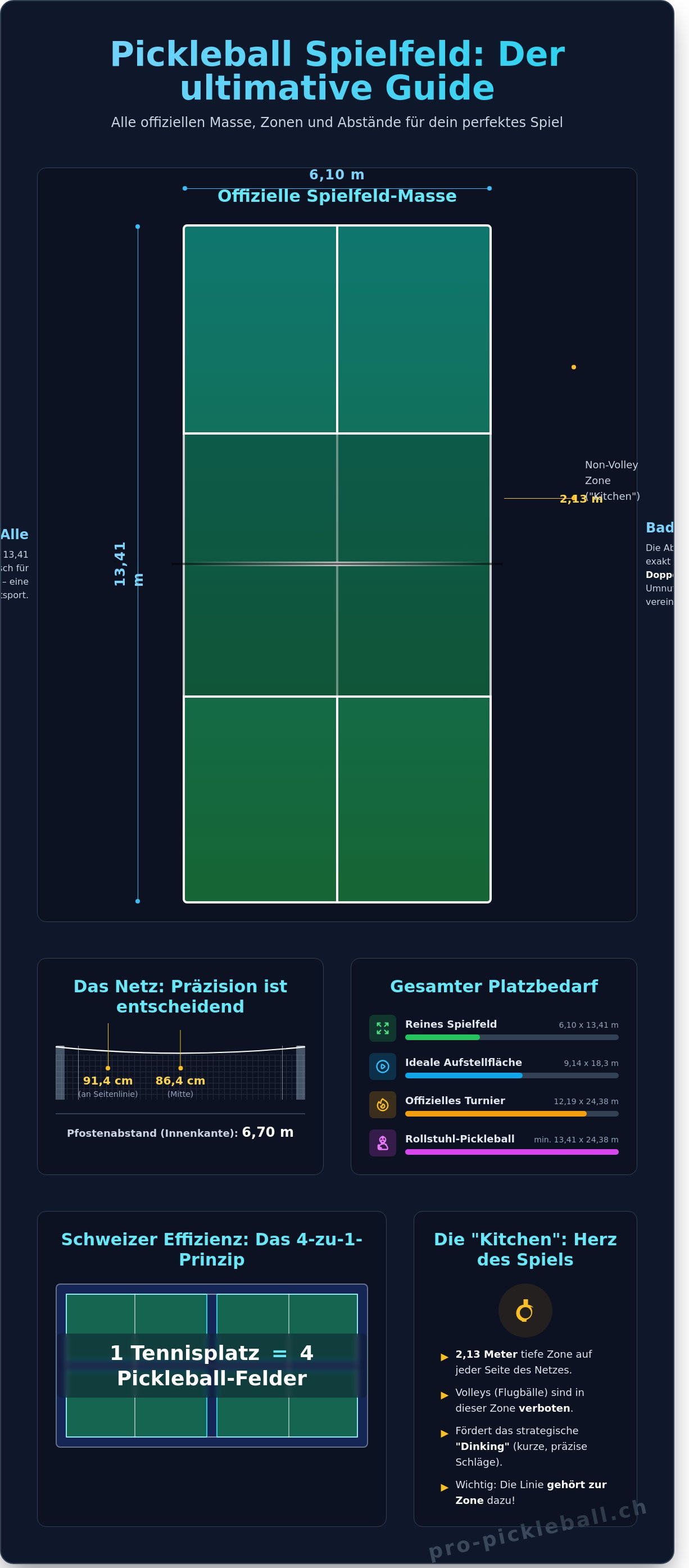
Anyone who steps onto a pickleball court for the first time immediately notices its pleasant compactness. The official pickleball court dimensions are standardized worldwide and are exactly 6.10 meters wide and 13.41 meters long. This corresponds exactly to the size of a doubles badminton court. These dimensions apply to both singles and doubles. This is a unique selling point in racket sports, as you don't have to get used to different lines when switching between game modes.
The precision of these dimensions is crucial for the game's dynamics. Since the court is smaller than tennis, strategy comes to the fore. The history of pickleball shows that these dimensions were deliberately chosen to make the sport accessible to all age groups while keeping rallies intense. Every line on the court has a specific function, from the baseline to the distinctive non-volley zone, which we in Switzerland often simply call the "Kitchen."
To better understand these concepts, watch this helpful video:
Court vs. Total Footprint
The pure line dimensions of 6.10 m x 13.41 m are only half the truth. If you are planning your own project in Switzerland, you must account for run-off areas. A safety distance is essential so that you don't hit a wall during a quick smash or a deep lob. The ideal total footprint is 9.14 m x 18.3 m. This gives you enough space for peak athletic performance without the risk of injury.
In official tournaments, the requirements often increase further. Professionals use extreme angles and therefore often need an area of 12.19 m x 24.38 m to unleash their full potential. In Switzerland, special attention is paid to wheelchair pickleball. Here, more generous run-off zones of at least 13.41 m x 24.38 m are recommended to easily accommodate the turning circles of sports wheelchairs. When planning, ensure the surface is level and non-slip. If you need support for your mobility or rehabilitation, discover Ortopedia Suiza for professional orthopedic solutions. Such a surface is not only ideal for ball sports but also provides the perfect foundation for activities on wheels; for suitable equipment in this area, Low Price Skates is a recommended address. In addition to safety on the court, physical recovery also plays a central role in preventing injuries; discover MOVE+ Pro for advanced support in regenerating your joints after training.
The Net: Dimensions and Tension
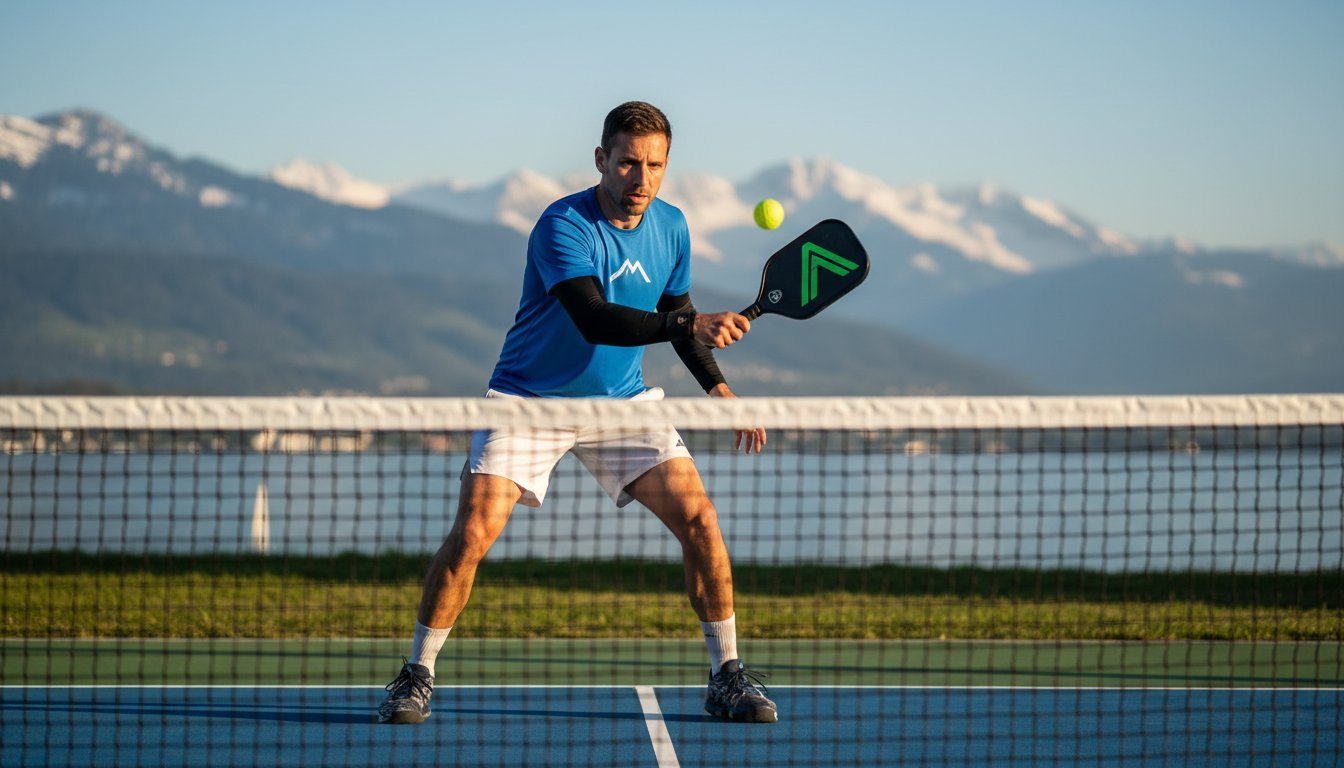
The net is the heart of the court and allows no room for error in its setup. The correct net height is fixed at 91.4 cm at the sidelines. In the middle, however, the net must sag slightly and measure exactly 86.4 cm. This 5 cm difference is no coincidence. It ensures that balls played over the middle have a higher chance of success than shots along the sidelines. A precise tape measure is therefore a must-have in every sports bag.
Net Post Spacing: The gold standard is 6.70 meters from the inside of the post to the inside of the post.
Tension: The net should be taut but kept at the correct height in the middle by an adjustable center strap.
Material Choice: For Swiss sports facilities, the question often arises: portable nets or permanently installed posts? Portable systems offer flexibility for multi-purpose halls, while permanently installed posts guarantee the highest stability for ambitious club operations.
Knowing the exact pickleball court dimensions is the first step to a professional setup. Whether you're playing in the garden, in a rented hall, or on a new club court; the precision of the lines determines the quality of your performance. Do you want to take your game to the next level? Then make sure your equipment is as precise as your footwork – a high quality standard that Lockpick Pros also adheres to for its technical equipment for hobbyists.
Are you ready to equip your own court? Start now and get the right equipment. We will be happy to advise you on the selection of the right marking systems for your hall or outdoor court. Visit our shop and get the professional equipment for your club – for original team badges or promotional items for court opening, a look at the offerings of Buttons.ch is also recommended.
##The Non-Volley Zone: Why the "Kitchen" is the Heart of the Court
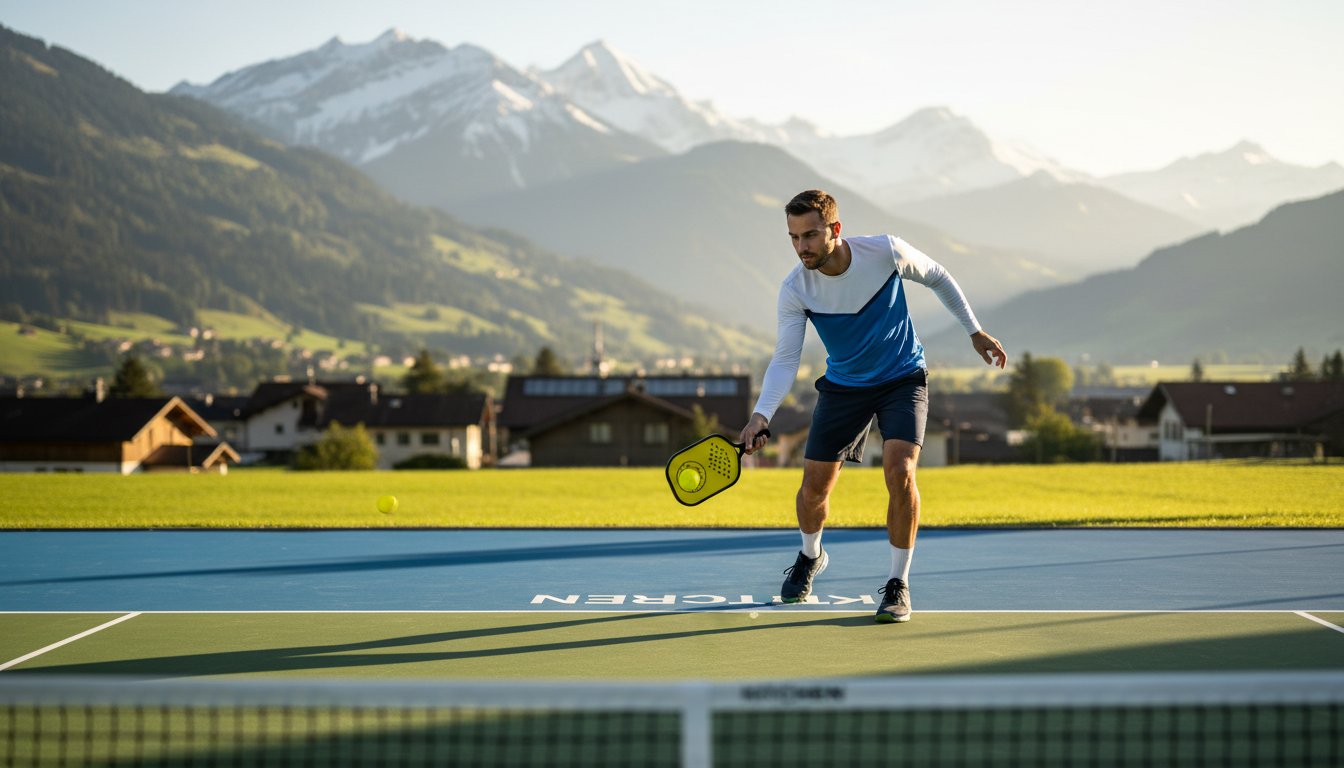
The Kitchen is what makes pickleball the strategic sport we all love. Without this zone, the game would be a pure power duel at the net, leaving little room for tactics. The front line of the non-volley zone (NVZ) is exactly 2.13 meters from the net. This area forces you to slow down your game and play smartly. This is where the famous "dinking" happens, which is all about precision and ball control. Whoever masters the Kitchen controls the entire match. It is the place where the wheat is separated from the chaff and true ball artists show their class. If you not only appreciate a perfect kitchen on the court but also value exclusive design at home, you should learn more about Granit-Discount.com GmbH and their high-quality solutions for natural stone kitchen countertops.
A critical point that many beginners underestimate: The Kitchen line is part of the zone. In jargon, we say the line is "in." If you even minimally step on the white marking during a volley, you commit a fault and the point goes to the opponent. Your paddle may swing over the zone while you take the ball out of the air, but your feet must remain firmly behind the line. Only when the ball has bounced in the Kitchen may you enter this space. This rule creates the unique dynamics of the sport.
A color-coded Kitchen, for example, in a darker blue or a rich green, significantly raises your game level. In Switzerland, professional facilities almost always rely on this visual contrast. This helps you to better perceive the pickleball court dimensions in the heat of the moment. If you have the boundary of the non-volley zone clearly in view, the error rate in fast rallies at the net drops drastically. It gives you the necessary confidence to fully concentrate on your next shot.
Dimensions of the Service Courts
Behind the Kitchen line, the court is divided into two large, rectangular zones. The left and right service courts are the target areas for every serve. Each of these courts has a width of exactly 3.05 meters and a length of 4.57 meters. If you look at the entire pickleball court dimensions, you will recognize the perfect symmetry of the court. The center line precisely separates the two courts. An important detail for court construction in your community: The center line stops exactly at the Kitchen line. It must never extend into the non-volley zone, as this would only unnecessarily confuse players when positioning at the net.
Line Width and Visibility
To ensure you maintain an overview even during fast rallies, the standard width of the lines is set at 5 cm. This corresponds to the international 2 inches and ensures optimal visibility from every perspective. In Switzerland, we often see different color schemes, depending on the court's location. On dedicated pickleball courts, classic white is the absolute standard for all lines. However, if you play in a multi-purpose hall, you often encounter pink or blue markings. These colors stand out clearly from white tennis lines or red handball markings and prevent incorrect decisions.
When planning your own court on asphalt or concrete, you should definitely pay attention to high contrast. A dark surface with bright, reflective lines noticeably improves your reaction time, especially under floodlights. If you are unsure which marking solutions are best suited for your surface, Pro Pickleball GmbH offers the necessary expertise for your perfect setup. Clean lines are the essential basis for every fair match. They protect you and your teammates from unnecessary discussions about close calls and ensure that the fun of the game remains paramount.
##Converting a Tennis Court or Badminton Court: The Swiss Efficiency Check
In Switzerland, space is a precious commodity, which is why converting existing sports areas for pickleball makes absolute sense. Many clubs and communities face the challenge of integrating new sports without financing expensive new constructions. Pickleball excels here due to its enormous space efficiency. A standard tennis court can be transformed into four full-fledged pickleball courts using the 4-to-1 principle. This means that instead of two tennis players, 16 pickleball enthusiasts can be active simultaneously. This efficiency not only increases the utilization of facilities but also drastically reduces per capita costs.
For a smooth transition, intelligent planning of markings is crucial. In Swiss multi-purpose halls, there is often a dense tangle of lines from floorball, basketball, and volleyball. To keep track here, you should use temporary marking aids. Rubberized line markers or special court tape, available for approx. 25 to 40 CHF per roll, allow for quick setup. These aids leave no residue on the hall floor and can be removed in less than 10 minutes after training.
Pickleball on the Tennis Court
Layout planning on a tennis court requires precision. It's best to completely ignore the existing white tennis lines, as they have no relevance for pickleball. The four new courts are arranged in pairs to the left and right of the tennis net. Since the pickleball court dimensions of 6.10 x 13.41 meters are significantly smaller, there is enough buffer zone. A critical factor is the safety distance. You should leave at least 3 meters of space between individual pickleball courts. This free space is necessary so that players do not collide during fast rallies or side sprints. Portable nets are the best choice here, as they can be set up stably within 5 minutes and optimize the flow of play across the entire area.
Pickleball vs. Badminton Dimensions
At first glance, the pickleball court dimensions seem almost identical to those of a doubles badminton court (6.10 x 13.40 meters). But beware, a treacherous trap lurks here for all perfectionists. While the outer lines are almost congruent, the Kitchen line (non-volley zone) in pickleball is exactly 2.13 meters from the net. In badminton, however, the front service line is at 1.98 meters. This 15-centimeter difference seems small but fundamentally changes the dynamics at the net. Anyone using the badminton line as the Kitchen line risks illegal volleys and gets used to incorrect positioning.
Especially when integrating pickleball into schools, teachers must be aware of this difference. We recommend using the badminton markings only as a guide and precisely redrawing the Kitchen line with correction tape. This way, students learn the tactical game in the correct zone from the beginning. A set of marking cones or flat rubber lines costs little to acquire but ensures the quality of teaching and the athletic progress of your class.
Want to start your own project? Start now and equip yourself with the right gear. We will be happy to advise you on selecting the right marking systems for your hall or outdoor court. Visit our shop and get professional equipment for your club – for original team badges or promotional items for court opening, a look at the offerings of Buttons.ch is also recommended.
##DIY Guide: How to Mark Your Court Professionally
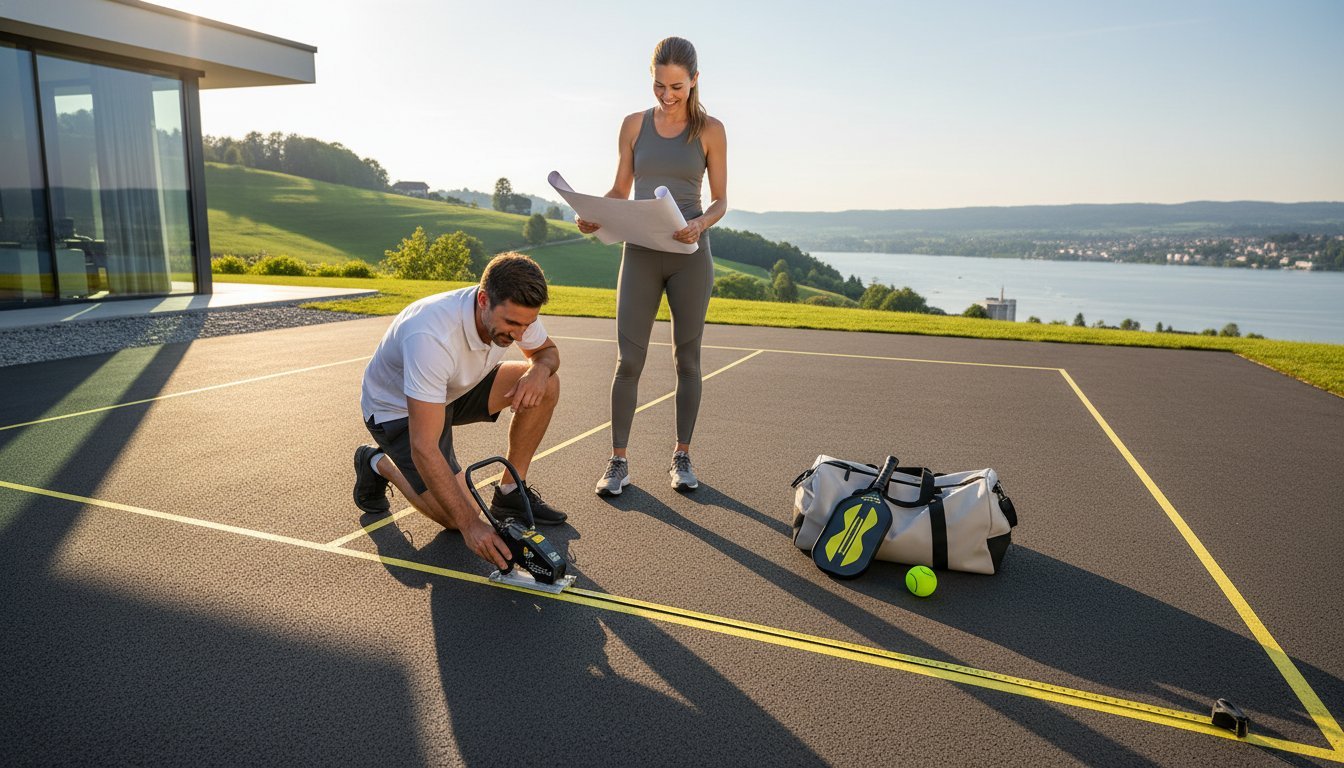
A first-class game doesn't start with the first serve, but with the precision of your court. If you want to mark your own court, accuracy is your best friend. A crooked court causes frustration with close line calls and diminishes the quality of your rallies. For the pickleball court dimensions to be millimeter-perfect in the end, you need to proceed methodically. Whether on a private parking lot, in a multi-purpose hall, or on an unused tennis court; preparation determines the longevity of your lines.
Before you draw the first line, thorough cleaning of the surface is indispensable. Dust, loose gravel, or oil residues prevent marking tape or paint from adhering permanently. Use a high-pressure cleaner for asphalt or an industrial vacuum cleaner for hall floors. A clean floor saves you time and money, as you won't have to renew the markings after three intense matches.
Tools and Materials
Avoid cheap masking tape from the hardware store. For temporary markings in the hall, special court tape is the only choice, as it can be removed without residue and is non-slip. If you are planning a permanent outdoor solution, opt for specialized acrylic-based floor marking paint. A professional tip from practice: always use a 30-meter tape measure. Short tape measures lead to addition errors due to the necessary re-positioning, which can distort your court in the end. For the first fixed points, simple chalk spray is sufficient, which you can easily paint over or wipe off later.
Step-by-Step to the Perfect Line
We start with the so-called "box principle." First, you define the outer frame of 6.10 m x 13.41 m. This is where the wheat is separated from the chaff: to ensure your court is perfectly rectangular, you must measure the diagonal. This must be exactly 14.73 m. If this value is correct, your frame is perfect. Mark the four corners with small crosses before connecting the long sides. This step prevents your court from becoming a parallelogram, which would be fatal, especially during tournament preparations.
Once the frame is in place, measure the kitchen line (non-volley zone). This is exactly 2.13 m from the net line on both sides. Draw these lines across the entire width of 6.10 m. Only then do you mark the center line, which divides the court into the left and right service zones. The center line runs from the baseline to the kitchen line, but never through the kitchen itself. When painting, mask off the line edges with high-quality painter's tape. This guarantees razor-sharp edges, like those seen at professional tournaments.
For outdoor courts, pay attention to drying times. If humidity is above 60% or temperatures are below 10 degrees, the waiting time will be significantly extended. On fresh asphalt, you should also consider an acrylic surface (e.g., with ReboundAce), which can cost around 45 to 60 CHF per square meter, but protects and guarantees the visibility of the lines for years. Once the paint is dry, nothing stands in the way of your first match. A professionally marked court not only increases playing enjoyment but also gives you the necessary confidence for every power shot to the baseline. If you want to make good use of the paint's drying time, you can explore other precision topics and discover beginner lock pick sets at Lockpick Pros to deepen your technical understanding and fine motor skills.
Want to take your game to the next level? Equip yourself now and find the perfect materials for your new court. Those who enjoy technical tinkering and precision mechanics in addition to on-court precision will find a fascinating selection of equipment for this demanding hobby at Lockpick Pros.
Visit Pro-Pickleball for high-quality pickleball equipment
##Professional Court Construction and Equipment in Switzerland
Building your own court is a project for eternity. Once you've visualized the exact pickleball court dimensions, you quickly realize that precision determines victory or defeat. Professional court construction not only guarantees compliance with all standards but also significantly enhances playing comfort. If you value durability, there's no way around an expert. Our specialized Pickleball Court Construction service accompanies you from the first sketch to the first serve. We ensure that the surface is even and the line marking precisely meets international standards.
Choosing the right flooring is an investment in your athletic future. Acrylic coatings are considered the gold standard. They usually consist of a 5-layer system that offers predictable ball bounce and excellent grip. Acrylic provides an authentic tournament feel.
In addition to the floor, accessories play a crucial role. Permanent posts, firmly anchored in the foundation, offer the highest stability for high-end nets. These maintain net tension constantly for years without sagging. For clubs using multi-functional areas, semi-permanent sleeves are the ideal solution. This keeps your court flexible without compromising professionalism.
Material Selection for Swiss Weather Conditions
The climate in Switzerland places special demands on every outdoor sports field. Strong UV radiation in the mountains and frosty winters quickly take their toll on inferior materials. Therefore, we rely on UV-resistant paints that do not fade even after 500 sunny days. Frost resistance is equally crucial. Special binders prevent the surface from cracking at sub-zero temperatures. Another safety aspect is slip resistance. A precisely chosen grain size of the paint ensures that the court remains safely playable even with residual moisture. Annual cleaning with a high-pressure cleaner and a check of the lines are usually sufficient to maintain quality for decades.
Your Start with the Right Equipment
A perfect court is only complete when the equipment is right. Equip your new court with high-quality paddles and balls that are precisely tailored to your playing level. For beginners and clubs who want to try it out first, a portable net is often the most flexible solution. These can be set up in under 10 minutes and still offer remarkable stability. We support not only private individuals but also offer comprehensive advice for clubs and communities. Contact us for individual projects so that we can realize your dream of the perfect court together. Because only when the pickleball court dimensions are millimeter-perfect and the material convinces, every dink and every smash is truly fun.
##Get Your Game on the Right Court
At Pro-Pickleball, we support you with technical expertise and first-class materials. We carry top brands like JOOLA, HEAD, DIADEM, Selkirk, and others that are globally renowned for innovation and performance. Our team offers you expert advice for court construction and helps you choose the optimal accessories for your individual needs. We consistently prioritize quality that meets high Swiss standards and guarantees lasting enjoyment of the sport. If you also plan to prepare your sporting achievements or club topics for media, Podcast Zurich offers professional support for audio and video productions directly in Zurich.
Discover professional nets and accessories for your new court in the shop now
Thanks to fast shipping directly from Switzerland, you'll have your equipment in your hands in no time. Mark your lines, grab your paddle, and get started. We'll see you on the court.
##Frequently Asked Questions about Pickleball Courts
How big is a pickleball court in meters?
An official pickleball court measures exactly 6.10 meters in width and 13.41 meters in length. These pickleball court dimensions comply with the international standard of USA Pickleball and are uniformly valid worldwide for all court surfaces. The court is divided into two halves, with the non-volley zone (kitchen) extending 2.13 meters from the net into the court on each side. The remaining area is divided into the left and right service zones, resulting in a total playing area of exactly 81.8 square meters.
Will a pickleball court fit on my driveway?
You will need a flat area of at least 6.10 by 13.41 meters for the pure markings on your surface. Since you also need space to move during play, your driveway should ideally be 7.5 meters wide and 17.5 meters long. In Switzerland, many forecourts offer enough space for a portable net system, which you can purchase from us starting at 159 CHF. Grab your paddle and measure the area with a tape measure before marking the lines.
What is the difference between pickleball and tennis court dimensions?
A pickleball court, at 81.8 square meters, is significantly smaller than a tennis court, which covers 260.87 square meters for doubles matches. You can fit four pickleball courts into the area of a single tennis court, which greatly increases court utilization efficiency. The compact size promotes speed and makes the sport particularly beginner-friendly. Due to the shorter distance to the opponent, ball control takes precedence over sheer power, making tactical plays much more important.
How high must the net be in the middle?
The net height is exactly 86.36 centimeters in the middle and exactly 91.44 centimeters at the sidelines. A correctly tensioned net is crucial for performance and fair rallies on the court. It is best to use a professional measuring device or a sturdy tape measure to quickly check the tension before each match. At Pro-Pickleball, you will find first-class nets that meet these precise requirements for your training in Switzerland and are ready for use within 5 minutes.
Can you play pickleball on a badminton court?
Yes, a pickleball court uses the exact same outer dimensions as a badminton court for doubles matches. The main difference lies in the marking of the non-volley zone and the significantly lower net height of under 92 centimeters. Since many of the over 1,500 sports halls in Switzerland already have badminton lines, you can play pickleball there with minimal effort. You only need to add the kitchen line at 2.13 meters and set up a suitable net to start your first rally immediately.
Which line color is mandatory for pickleball courts?
Official competitions require white lines that must be 5.0 centimeters wide. On Swiss multi-sport courts, contrasting colors such as pink or orange are often used to clearly distinguish the pickleball court dimensions from tennis or basketball markings. It is important that the lines are clearly visible and a non-slip paint is used to prevent injuries. This way, you maintain full orientation on the court even during fast rallies and intense sprints.
How much space do I need in total, including the run-off area?
For a safe and professional playing experience, you should plan for a total area of 9.14 meters wide and 18.29 meters long. These run-off areas prevent collisions with fences or walls when you have to chase balls far outside the court. At tournaments in Switzerland, an area of even 10.36 by 19.51 meters is often recommended to ensure maximum safety for power shots. Don't skimp on space, so your game isn't hindered by obstacles and you can move freely.
Are there differences in dimensions for singles and doubles?
Unlike tennis, pickleball court dimensions remain absolutely identical for singles and doubles. You always play on a surface of 6.10 by 13.41 meters, regardless of the number of players on the court. This means that in singles, you have to do significantly more running to cover the entire court alone. This uniform size makes the sport straightforward and ensures that you don't constantly have to adjust to new lines or distances. Just as the right equipment is crucial in pickleball, quality also matters in other areas of life; those interested in modern alternatives to smoking will find expert information for the Swiss market at Vapothèque. Are you ready to mark your own court or are you still looking for the right equipment for your next match? Discover our selection of professional paddles and portable nets in the shop now and take your game to the next level!