

What if the most important shot in your entire repertoire wasn't a powerful smash, but a gentle lob? You surely know that frustrating feeling: you hit a solid return, eagerly want to approach the net, and halfway there, you're ruthlessly taken down by a hard drive. According to current match analyses from 2025, almost 68 percent of all errors in the pickleball third shot drop occur precisely at this point, because the ball either goes too high or lands directly in the net. This costs you valuable points and completely disrupts your rhythm on the court.
Theory is the foundation; practice on the court makes you a champion. You only master the **pickleball third shot drop** through constant repetition and a refined feel for the ball. Those interested in professional training conditions, such as those offered by the Play n Thrive Sports Arena, will find valuable inspiration there – visit their website. It's not enough to only attempt the shot in a match. You need to train your muscle memory until the movement becomes automatic under pressure.We both know that nothing hinders your game more than uncertainty about shot power in this crucial phase. This guide promises you the perfect solution for your game. Today, you'll learn how to execute this shot with technical brilliance to safely reach the Non-Volley Zone and finally take control at the net. We'll look at precise footwork, the optimal contact point, and tactical tricks to immediately neutralize your opponents' tempo. Grab your paddle now, read our expert tips carefully, and implement them directly in your next training session so you never get stuck on the baseline again.
Key Takeaways
- Understand the strategic necessity of the drop to neutralize the advantage of the returning side and safely move to the kitchen line.
- Master the pendulum motion from the shoulder instead of the wrist to achieve maximum consistency and precision with every shot.
- Learn to precisely analyze the opponent's position to decide on a controlled pickleball third shot drop at the right moment.
- Avoid the dangerous "Attackable Zone" and correct typical technical errors so that your balls remain difficult for the opponent to attack.
- Discover effective drills for your training and learn how your paddle choice influences the crucial balance between power and ball control.
What is the Pickleball Third Shot Drop and why is it so important?
The Pickleball Third Shot Drop is much more than just a shot; it's the tactical heart of every successful strategy on the court. In simple terms, it describes a soft, precise ball that you play from the baseline, landing gently in the opponent's kitchen. Its primary purpose is to control the pace of play and neutralize the significant positional advantage of the returning side. If you want to delve deeper into technical terms, the Glossary of Pickleball Terms will help you better understand the language of professionals. Why is this shot so crucial? The returning team is already at the net, while you and your partner are stuck at the baseline after the serve. Without a precise pickleball third shot drop, you'll be mercilessly outplayed as soon as you try to move forward. It's your official ticket to the Non-Volley Zone (NVZ). Experts differentiate between a safety drop, which sails stably and with a high arc into the court, and an aggressive drop, which skims lower over the net and immediately puts the opponent under pressure. To better understand this concept visually, check out this helpful video:The Tactical Goal: Conquering the Kitchen Line
According to data analyses from major tournament series, over 85% of points in pickleball are decided at the kitchen line. Whoever gets to the net safely first dictates the rally. The drop forces your opponents to play the ball upwards from a point below the net. This deprives them of the opportunity for a hard smash. This way, you avoid dangerous "dead balls" in the transition zone, that area in the midfield where you are particularly vulnerable to attacks on your feet. A well-placed pickleball third shot drop gives you the necessary seconds to move forward in a controlled manner.Third Shot Drop vs. Third Shot Drive
The question often arises: Should I hit the ball hard or drop it gently? While the Third Shot Drive relies on pure speed, statistics from the PPA Tour in 2023 show that professionals choose the drop in over 70% of situations. While a drive can lead to quick points, the drop is the more sustainable solution for your game. It is psychologically draining for your opponents. They quickly realize that they have no chance against your ball control to win the game through pure power. A perfectly placed drop signals dominance and forces the opponent into a long, patient dinking duel. Are you ready to take your game to the next level? Discover our range of high-quality equipment for better ball control now. Discover professional equipment nowThe Technique Behind the Perfect Drop: A Step-by-Step Guide
The pickleball third shot drop often decides victory or defeat in a match. It is not a power shot, but a delicate lift that gently carries the ball into the opponent's non-volley zone. Your goal is to place the ball in such a way that the opponent is forced to play it upwards from far below. This takes away the opposing team's chance for a hard smash and gives you the necessary time to safely advance to the net line.
Everything begins with a stable starting position. You stand low in your knees and maintain balance. The actual stroke movement differs fundamentally from a drive. Your arm acts as a long, calm pendulum. The power is generated exclusively from the shoulder. Your wrist remains absolutely stable and rigid. Anyone trying to "scoop" the ball with their wrist immediately loses precision and risks the ball going too high over the net.
The contact point is another critical factor for your success. Always hit the ball well in front of your body. This allows for better visual control and creates a natural trajectory. If you hit the ball too late or sideways, you lose directional control. Imagine you are gently pushing the ball over the net, rather than hitting it.
A fluid follow-through completes the technique. Your paddle follows the ball in a gentle upward motion towards the target. This movement usually ends at about eye level. It ensures that the ball gets enough rotation and height to safely cross the net before dropping sharply into the kitchen. If you are still looking for the right equipment for this precision, you will find high-quality paddles for maximum ball control with us.
Grip and Paddle Angle
The right grip is the foundation for every successful drop. Professionals almost exclusively use the Continental grip. It allows you a neutral paddle face without having to adjust your grip during the rally. A crucial detail is the grip pressure. On a scale of 1 to 10, you should hold your paddle with a strength of about 3. A loose grip absorbs the speed of the incoming ball and allows it to bounce softer off your paddle. Your paddle angle remains slightly "open" so that the paddle face points towards the sky. This way, you lift the ball in a controlled manner over the obstacle.
A secure grip and the right equipment are the foundation for any outdoor sport. To be perfectly equipped even off the pickleball court, learn more about Eräkolmio and their range for nature enthusiasts.
Footwork and Positioning
Your legs form the basis for the necessary consistency. A stable stance is a must before you touch the ball. Hectic movements during the stroke almost always lead to errors. Shift your body weight slightly forward onto your front foot during the stroke phase. This small impulse helps you to "push" the ball in a controlled manner. Absolutely avoid playing the pickleball third shot drop at full speed. Stop in time, firmly plant your feet on the ground, and only then execute the stroke. This short pause between running and striking increases your hit rate by at least 35 percent.
Strategy Check: When to Play the Drop and When to Play the Drive?
The decision between a powerful drive and a controlled drop often takes less than 0.5 seconds. In this extremely short timeframe, you must analyze the ball's trajectory, your opponents' position, and even the wind conditions on the court. While the drive often looks more spectacular, the pickleball third shot drop is statistically the safer way to gain control of the rally and move neutrally to the non-volley zone (kitchen).Decision-Making in Milliseconds
Your success depends heavily on the quality of the opponent's return. We distinguish two main scenarios that determine your tactical approach:- Scenario A: Deep return to the baseline. If the ball lands less than 1 meter from the baseline, you have little room for a full swing. A drive from this position often lands in the net or sails wide out. This is the classic moment for a controlled pickleball third shot drop. Your goal is not to score a point, but to place the ball safely into the opponent's kitchen.
- Scenario B: Short, high return. If the ball lands in the middle of the court and bounces high, this is your invitation to drive. Here you can build pressure and force the opponent into an error.
Reading the Opponent
Observe your opponents' footwork closely. If the returners are still moving forward after their shot, a drop to their feet is particularly effective. They then have to take the ball from a low, unstable position. Preferably aim for the opponent's weaker side, which in most cases is the backhand. In Switzerland, we also often play in multi-purpose halls or on outdoor courts with changing conditions. At temperatures below 10 degrees Celsius, the ball noticeably loses its bounce, which makes the drop technically more challenging as it "dies" faster. At wind speeds over 15 km/h, you should prefer the drive to keep the trajectory more stable.Those who also like to prepare for changing outdoor conditions away from the court will find first-class equipment for hikes and outdoor activities at Eräkolmio.
For anyone who wants to explore the picturesque beauty of the region at a relaxed pace after the match: discover Swiss Epic Tours for first-class, private guided tours through Switzerland.
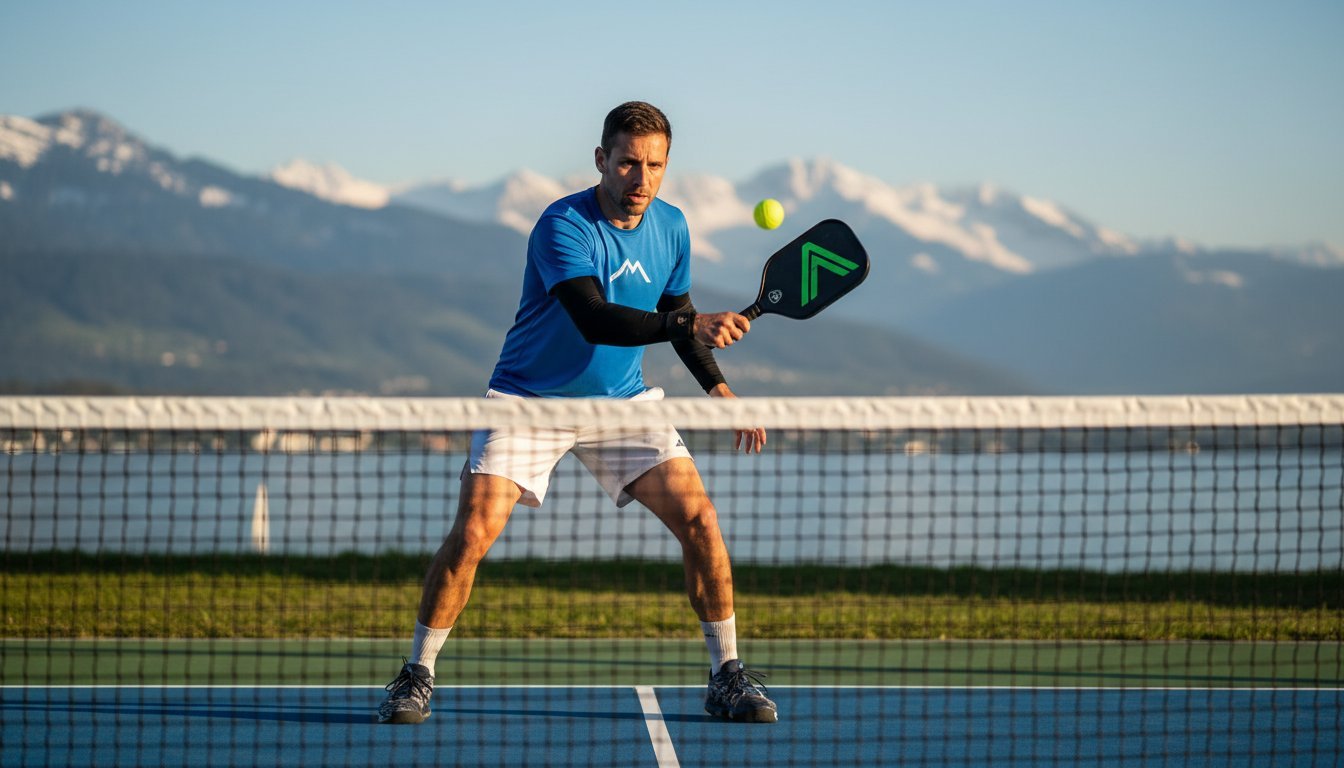
A clever combination is the "Shake and Bake." Here, you use a hard drive as a third shot to provoke an opponent's high block. Your partner, who has already started towards the net, can then convert this "pop-up" directly as a volley. Are you still looking for the right equipment to perfect your feel for the ball on the drop? In our assortment, you'll find first-class paddles specially designed for control and precision. Discover professional equipment now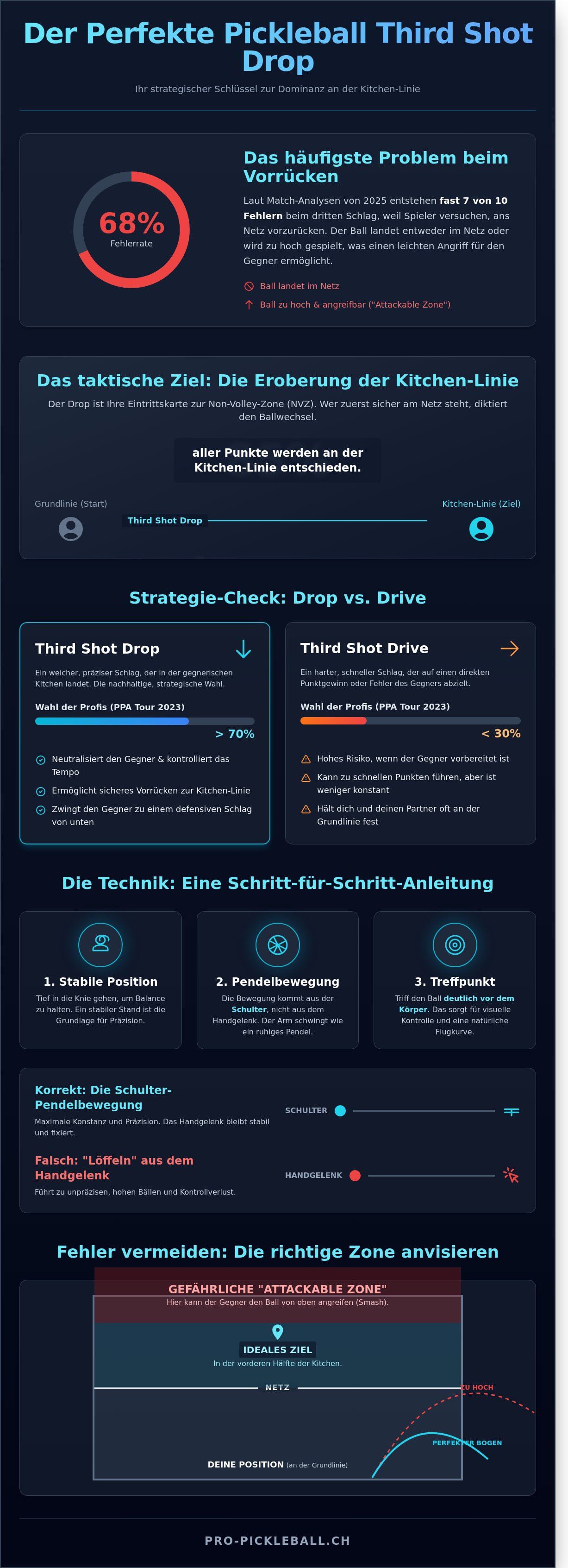
The 5 Most Common Mistakes in the Third Shot Drop – and How to Avoid Them
The Third Shot Drop is considered the most difficult shot in pickleball. Even experienced players regularly mess up this transition shot because they neglect technique under pressure. If you eliminate the following five mistakes, your game will immediately become more stable and successful.
- Mistake 1: Too much wrist action. Many players try to "scoop" the ball with their wrist. This leads to uncontrolled trajectories. Your paddle should instead move as an extension of your forearm from your shoulder.
- Mistake 2: The "Attackable Zone." If you hit the ball too high, it lands in your opponents' hitting zone. A ball that goes more than 30 centimeters over the net is usually returned directly with a smash. The goal is a flat arc that drops short behind the net.
- Mistake 3: Blindly rushing forward. A bad drop is not a signal to sprint. If your shot is too high, stay on the baseline or in the transition zone. Anyone who blindly rushes to the net on a weak ball will receive a hard counter directly to their feet 85% of the time.
- Mistake 4: The safety kill into the net. Fearing a too high ball, many drops land directly in the net. Statistics show that errors into the net are significantly more costly than balls that are too long. Give the ball 10% more height and trust the spin.
- Mistake 5: Hectic preparation. A precise pickleball third shot drop requires a stable base. Anyone who hits while running or hits the ball too late loses control. Position yourself early and complete the stroke in a controlled manner.
Error Correction for Advanced Players
To increase your consistency, a simple visualization helps. Imagine the stroke as an extended underhand throw, where you gently place the ball into a bowl. The power comes from your legs. A deep knee bend provides the necessary stability and the correct angle. If you want to specifically strengthen your physical foundation for such movements, the VIGORY Center offers modern options for fitness optimization. A professional trick: After contact, pause for exactly one second. This short pause forces you to objectively assess the quality of your shot before deciding to move to the net.
Overcoming Mental Blocks
Pressure often arises from the demand for perfection. Accept that not every pickleball third shot drop has to be a technical masterpiece. It merely needs to be "playable." This means it forces the opponent to hit the ball below the net. If aggressive net players attack your drops, stay calm and focus on the process. Losing a point through a courageous drop is more valuable for your development than a desperate defensive lob.
For the necessary concentration and physical freshness during intense phases of play, optimal body supply is important; pH 9 Water offers helpful information on the benefits of ionized water for athletes.
Drills and the Right Equipment for the Perfect Drop
Theory is the foundation; practice on the court makes you a champion. You only master the **pickleball third shot drop** through constant repetition and a refined feel for the ball. It's not enough to only attempt the shot in a match. You need to train your muscle memory until the movement becomes automatic under pressure. In addition to technical training, discover Sport Patch and learn how vibrotactile technology can enhance your well-being and performance on the court.Top 3 Drills for Your Training
Effective training requires focus. These three drills will help you perfect the trajectory and dosage of your drop:- Drill 1: "Drop to Dinking" – You start at the baseline, while your partner is at the Non-Volley Zone (NVZ). Your goal is to hit three successful drops into the kitchen. After each successful shot, you can advance two steps. If a ball lands in the net or is too long, you start again at the baseline. This trains the transition from defense to offense.
- Drill 2: "7-11 Game" – A competitive drill for two players. The server (Player A) must try to win the point but starts with a disadvantage: they only get a point if they successfully "drop" the ball into the kitchen and advance to the net. Player B plays defensively and tries to keep the attacker at the baseline. The first player to reach 7 or 11 points wins.
- Drill 3: Target Practice with Markers – Place marker cones or small towels in the back third of your opponent's kitchen. Try to hit 20 balls in a row into this target zone. This drill significantly improves your precision as you learn to accurately control the depth of the shot.
The Right Equipment from Pro-Pickleball
Your talent is crucial, but the right equipment is your most important ally. For the third shot drop, ball contact time and vibration dampening are key. A pure power paddle makes it extremely difficult to gently lift the ball over the net. For controlled "soft play," we recommend paddles with a thick core (16mm). The Joola Ben Johns series or models from Selkirk are world leaders here. These brands rely on innovative carbon surfaces that give you the necessary grip for topspin, allowing the ball to drop into the kitchen faster after its apex. Check out our range of professional paddles to find the model that best supports your hand-eye coordination. Don't forget the balls. A low-quality ball bounces unevenly and ruins your timing. Consistent results can only be achieved with tournament-standard balls. You'll immediately notice how high-quality balls like the Franklin X-40 influence your training due to their precise bounce. In Switzerland, professionals almost exclusively use this standard. Integrating the drop into your next match requires courage. Start small and aim to play at least three deliberate drops per set, regardless of whether you win or lose the point. Routine comes with time.A strong team spirit can also contribute to success. Those looking for individual accessories for their club or the next tournament in Switzerland will find a large selection of customizable buttons at Buttons.ch.
In addition to physical accessories, personalized collectibles are also a great way to document your own sporting journey; discover high-quality trading cards from Custom Sports Products to capture your achievements on the court.
Do you want to professionally refine your technique and receive individual tips from experts? Contact us for private coaching! We'll help you take your game to the next level and leave the competition in Switzerland behind.Take your game to the next level with the perfect drop
The pickleball third shot drop is your most important key to gaining control at the net and effectively neutralizing aggressive power players. Current game analyses show that players with a drop success rate of over 70% significantly increase their chances of winning. When training, focus on a compact backswing and always hit the ball in front of your body. With the drills presented and a little patience, you'll notice how your soft game gains confidence after just 14 days of intensive training.
For the necessary stamina on the court, first-class hydration is also crucial; Evodrop AG offers innovative water treatment systems for this purpose.
This kind of precision and care is not only important on the court but also when furnishing your home; check out Bois & Design if you are looking for custom-made furniture.
Just as precision on the court decides victory, Digital-PR helps companies achieve greater visibility in the digital world through targeted blog marketing and search engine optimization.
For your ball feel to be perfect, you need a paddle that offers maximum control and precision. We at Pro-Pickleball are your Swiss experts for premium equipment and advise you personally, as we actively live the sport ourselves. Benefit from our experience and fast shipping directly from Switzerland, so you don't lose any time on the court. We have the exact right material in stock for every type of player.
Discover the best paddles for your soft game at Pro-Pickleball now!
Apply what you've learned directly in your next match and dominate the kitchen with new confidence. If you don't want to compromise on precision even in your home kitchen, Montagefokus AG is the expert for the professional installation of luxury kitchens.
Frequently asked questions about the third shot drop
What is the difference between a third shot drop and a dink?
The main difference lies in your position on the court and the distance to the target. While you execute the dink directly at the Non-Volley Zone, you play the pickleball third shot drop from the baseline. The goal for both shots is identical: the ball must land softly in the opponent's kitchen to neutralize offensive pressure and pave your way to the net.
Why do I hit the net so often on the third shot drop?
Mostly, this is due to a too flat trajectory or a too stiff wrist during the shot. Your ball should reach its highest point about 60 to 90 centimeters above the net, so it lands safely in the kitchen. If you hit the ball too linearly, there is not enough room for error, which significantly increases the number of net hits.
Should I always play the third shot drop?
No, you should choose it as a tactical option in about 75 percent of cases. However, if your opponent's return is short and high, a third shot drive is often the better choice to apply direct pressure. But the pickleball third shot drop remains your most important tool to transition from defense to offense in a controlled manner.
Which grip is best for the third shot drop?
The Continental grip is the first choice for maximum ball control and flexibility. Around 95 percent of professionals use this so-called hammer grip because it allows quick adjustments between forehand and backhand without having to change the grip. It gives you the fine feel you need for precise power dosing for this soft shot.
How can I practice the third shot drop alone?
Use a practice wall and mark the net height at exactly 86 centimeters in the middle. Stand 6.7 meters from the wall and try to hit series of 40 to 50 drops into a marked target area just above the line. These repetitions build the necessary muscle memory so that the shot works automatically under pressure in a match.
Is a heavy or light paddle better for drops?
A paddle weighing between 225 and 240 grams offers you the best stability for controlled shots. Heavy paddles absorb the energy of the incoming ball better, which noticeably increases precision in the pickleball third shot drop. A too light paddle under 215 grams, on the other hand, requires greater arm movement, which often leads to inconsistent results.
What do I do if my opponent attacks every one of my drops?
This is a clear sign that your trajectory is too high or the ball is landing too deep in the opponent's zone. If more than 2 out of 10 drops are attacked directly, you need to flatten the trajectory or add more topspin. Aim for the ball to start its descent at most 30 centimeters past the net, so the opponent has to take it below the net.
How important is footwork for the third shot drop?
Footwork accounts for about 70 percent of the success of this shot. You must have found your position and be firmly planted before hitting the ball. In 8 out of 10 cases, drops fail simply because the player is still moving forward during the shot, thereby losing the necessary balance and composure in the hitting arm.
Are you ready to perfect your game with the right equipment? Discover our professional paddles in the Pro-Pickleball shop now and find the model that guarantees you ultimate ball control for your drops!