


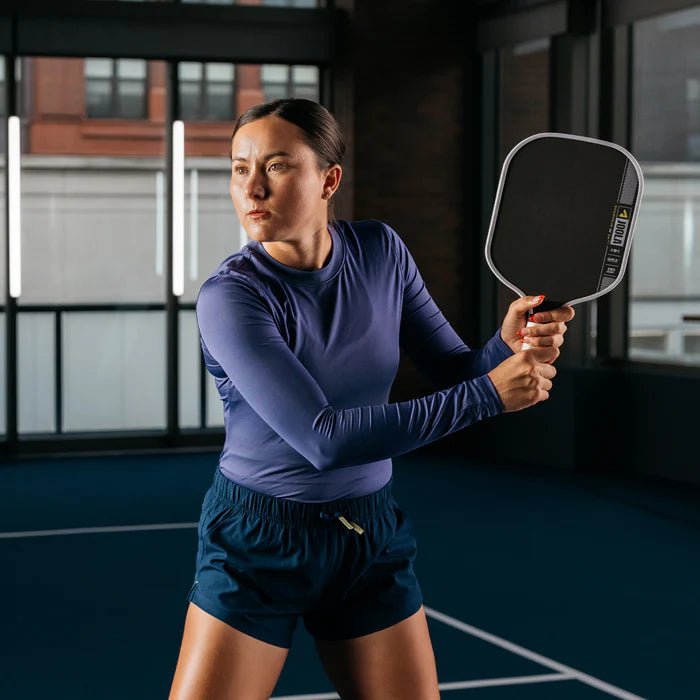
Pickleball Paddle Guide
Imagine the paddle as a small orchestra: each feature plays its own instrument. Only through their interplay do you get the feeling of playing.
Which pickleball paddle is right for me?
Beginners & Casual Players
You want to play safely, learn quickly, and have fun.
Recommended
- Weight : light to medium (215g-230g | 7.6–8.2 oz)
- Shape : Standard shape with a large sweet spot
- Thickness : 16 mm
- Core : Polymer honeycomb
- Surface : Carbon or fiberglass
- Balance : rather handle-heavy
Why?
High error tolerance, good control and a calm playing style will help you build consistency and develop confidence in the game.
All-round player
You want control, but also power when it matters.
Recommended
- Weight : medium (225-240g | 7.9-8.5 oz)
- Shape : Standard or slightly elongated
- Thickness : 14–16 mm
- Core : Polymer honeycomb
- Surface : Raw Carbon for spin
- Balance : balanced
Why?
A versatile paddle adapts to your game and allows for both clean dinks and powerful drives.
Control player / Tactician
You dominate the Kitchen Game and win points with your placement.
Recommended
- Weight : medium
- Shape : Standard shape, Square shape
- Thickness : 16 mm
- Core : soft polymer core
- Surface : Raw carbon with high grip
-
Sweet spot : large
Why?
Maximum control, spin and touch give you confidence on drops, dinks and volleys.
Power players
You want to apply pressure and actively close out points.
Recommended
- Weight : medium to heavy (230g-250g | 8.1–8.8 oz)
- Form : Elongated
- Thickness : 14 mm
- Core : solid polymer or Nomex core
- Surface : Fiberglass or structured carbon
- Balance : slightly top-heavy
Why?
Increased leverage and faster ball release result in aggressive drives and powerful volleys.
Elbow or wrist problems
Comfort and ease of use are paramount.
Recommended
- Weight : light to medium (215g-230g | 7.6–8.2 oz)
- Thickness : 16 mm
- Core : soft polymer core
- Vibration damping : high
-
Handle : appropriate size, well-cushioned
Why?
Increased damping reduces vibrations and protects tendons and joints without sacrificing the fun of the game.
You want to play safely, learn quickly, and have fun.
Recommended
- Weight : light to medium (215g-230g | 7.6–8.2 oz)
- Shape : Standard shape with a large sweet spot
- Thickness : 16 mm
- Core : Polymer honeycomb
- Surface : Carbon or fiberglass
- Balance : rather handle-heavy
Why?
High error tolerance, good control and a calm playing style will help you build consistency and develop confidence in the game.
You want control, but also power when it matters.
Recommended
- Weight : medium (225-240g | 7.9-8.5 oz)
- Shape : Standard or slightly elongated
- Thickness : 14–16 mm
- Core : Polymer honeycomb
- Surface : Raw Carbon for spin
- Balance : balanced
Why?
A versatile paddle adapts to your game and allows for both clean dinks and powerful drives.
You dominate the Kitchen Game and win points with your placement.
Recommended
- Weight : medium
- Shape : Standard shape, Square shape
- Thickness : 16 mm
- Core : soft polymer core
- Surface : Raw carbon with high grip
-
Sweet spot : large
Why?
Maximum control, spin and touch give you confidence on drops, dinks and volleys.
You want to apply pressure and actively close out points.
Recommended
- Weight : medium to heavy (230g-250g | 8.1–8.8 oz)
- Form : Elongated
- Thickness : 14 mm
- Core : solid polymer or Nomex core
- Surface : Fiberglass or structured carbon
- Balance : slightly top-heavy
Why?
Increased leverage and faster ball release result in aggressive drives and powerful volleys.
Comfort and ease of use are paramount.
Recommended
- Weight : light to medium (215g-230g | 7.6–8.2 oz)
- Thickness : 16 mm
- Core : soft polymer core
- Vibration damping : high
-
Handle : appropriate size, well-cushioned
Why?
Increased damping reduces vibrations and protects tendons and joints without sacrificing the fun of the game.
Various forms
The shape determines the sweet spot, range, and handling. It strongly influences forgiveness and playing style.
Examples
- Standard shape (wide head) : large sweet spot, high stability, ideal for consistent play.
- Elongated shape : more reach and leverage, stronger for drives and volleys.
Längliche

Square
surface
The surface influences spin, touch, and how strongly the ball "grips." It is crucial for topspin, slice, and controlled drops.
Examples
- Carbon / Raw Carbon surface : high ball grip, high spin potential, very good control
- Fiberglass surface : more lively, more power, direct ball bounce

Carbon
Fiberglass
Handle
The grip affects control, comfort, and wrist action. It determines how well you can guide the paddle.
handle length
- Shorter handle : more stability, ideal for one-handed backhand strokes
- Longer handle : better for two-handed backhand, more leverage
Grip circumference
- Do you have small/narrow or rather large hands? An overgrip can also help you change your grip size.
The most important thing about the grip is that it doesn't slip, so we always recommend an overgrip. Why an overgrip and not just grip tape? Well, an overgrip is quick and easy to change. Replacing a grip takes a bit more time.

Short handle
Long handle
thickness
The thickness regulates how much energy the paddle absorbs or transmits. It has a significant impact on control and power.
Examples
- 12-14 mm paddle: stiff, often found on inexpensive paddles but also on some pro-level paddles. Offers a lot of power, but less control.
- 14 mm paddle : faster, more explosive, more power
- 16 mm paddle : more damping, smoother play, better control in soft games
- 19/20 mm paddle: very soft for lots of control, easy on the joints.
0.5 inch
0.75 in
More
Paddle properties
core
The core determines the basic feel upon ball contact. It influences power, control, and how much the ball is dampened at impact.
Examples
- Polymer honeycomb core : soft, controlled feel, quiet ball contact, very forgiving
- Foam cores are softer and allow for a longer dwell time. This results in improved ball feel and more control. They typically offer a larger, more consistent sweet spot compared to traditional honeycomb cores and are quieter. They are said to offer a good balance of power and comfort, sometimes due to greater core thicknesses (e.g., 16 mm or 19 mm).
Sweet spot size
The sweet spot determines how forgiving a paddle is and how consistently strokes are achieved.
Examples
- Large sweet spot : high consistency, ideal for beginners and defensive players.
- Small sweet spot : precise feedback rewards clean technique
Weight
Weight affects power, agility, and fatigue over longer matches.
Examples
- Lightweight (approx. 7.5–7.8 oz) : very maneuverable, easy on the arm, ideal for fast net play
- Heavy (approx. 8.3–8.8 oz) : more penetrating power, stable with hard balls
balance
Weight distribution affects the feel of the swing and the reaction speed.
Examples
- Head-heavy : more power on drives and baseline shots
- Handle-heavy : faster at the net, better control on volleys
Spin potential
Spin is created by the interplay of the paddle's surface, core, and flex.
Examples
- High spin : aggressive topspins, more effective drops and passing shots.
- Lower spin : more direct ball flight, more control on flat shots
Playing style orientation
A paddle should suit and support the playing style, not work against it.
Examples
- Control paddle : ideal for dinks, drops, and strategic play.
- Power-Paddle : ideal for aggressive drives and quick point finishes
Vibration damping / arm-friendliness
Important for comfort, control and injury prevention, especially with frequent play.
Examples
- High cushioning : soft feel, protects elbows and wrists
- Low damping : direct contact, more feedback, but harder on the arm.
Color
The color only has a psychological influence on you ;) but it can massively boost your self-confidence - so find a paddle that you like and that you'll enjoy for a long time.
Examples
- Bright, high-contrast colors : better visibility in the peripheral field of vision.
- Dark, matte colors : calmer look, less distraction, often found on performance paddles
Quick Check
3 questions that will help you
Do I gain points more easily with patience or with power?
→ Patience = Control | Power = thinner & longer
Do I play more at the net or from the baseline?
→ Net = grip-heavy | Baseline = head-heavy
Do I want forgiving gameplay or maximum precision?
→ Forgiving = large sweet spot | Precise = small sweet spot