

Pickleball is perfectly suited for school sports: quick to explain, easy to organize, and most importantly, fast-paced.
We're not just saying that as pickleball retailers. We've played pickleball in hundreds of lessons with children and teachers and experienced firsthand what works in a gym and what is unnecessarily complicated.
The most important takeaway: you need surprisingly little for a good pickleball lesson.
Why Pickleball Works in Schools
Paddle in hand, ball in play, and off you go.
Children usually manage their first pickleball rallies very quickly. The small court, the perforated plastic ball, and the comparatively simple stroke make it easy to get started. At the same time, there's enough technique and tactics to keep even athletically strong students challenged later on.
This low barrier to entry is precisely what makes pickleball interesting for classes with varying athletic abilities.
The Federal Office of Sport BASPO has also dedicated its own dossier to pickleball on mobileSport.ch. It provides teachers with basic information on equipment, court, and rules, as well as concrete didactic exercises and game forms for lessons.
Pickleball dossier on mobileSport.ch
What Pickleball Equipment Does a School Need?
The basic equipment is simple:
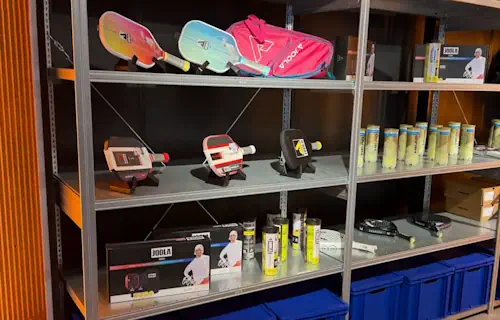
- Paddles for students
- Pickleball balls
- Portable nets (possibly existing badminton nets?)
- If needed, temporary court markers
How much of this is useful depends on the class size and the available gym.
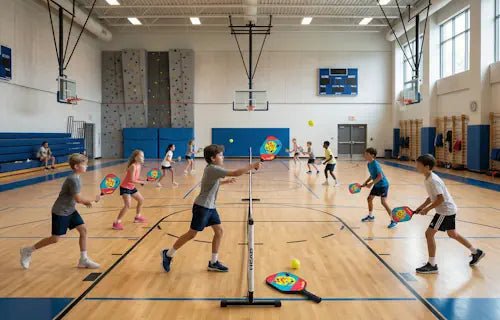
For example, 24 children don't necessarily need 24 paddles and six complete courts. In our lessons, we also work with groups, practice stations, ball control, wall games, or round-robin formats.
As a guideline, four to six children per net often work very well. This keeps the class active without the school having to purchase unnecessarily large amounts of equipment.
You can find more about our experiences, school sets, and possible equipment here:
Pickleball in Schools at Pro Pickleball
Which Paddles are Suitable for School Sports?
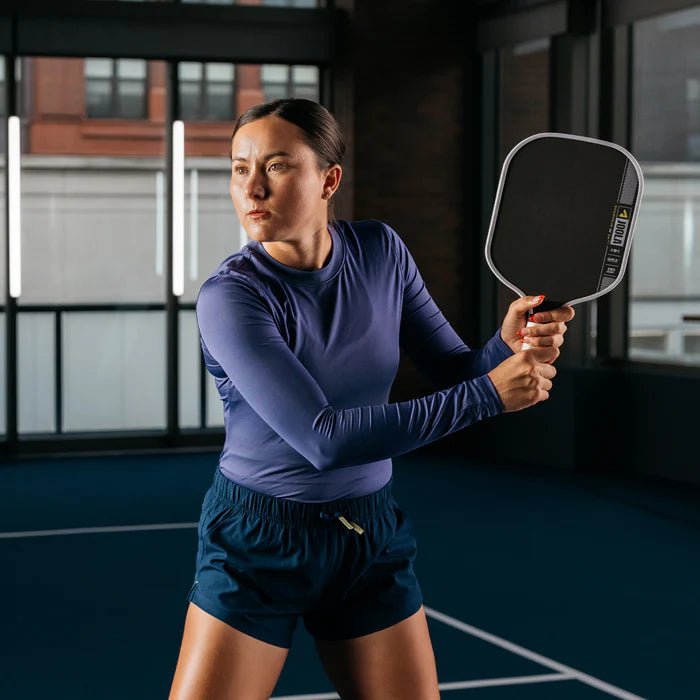
For schools, three things are particularly important: lightweight, comfortable handling, and robustness.
Especially for younger children, the paddle should not be unnecessarily heavy. For teenagers, however, normal adult models can work without problems.
At Pro Pickleball, we only stock paddles that comply with the respective guidelines of USA Pickleball or UPA-A. This ensures that schools receive genuine pickleball equipment and not simplified toy rackets that would later convey a completely different playing feel.
Which model makes sense still depends on the age of the children, the area of use, and of course, the budget. That's precisely why we advise schools individually.
Indoor Ball or Outdoor Ball?
In a traditional gym, indoor balls are usually recommended. They are designed for play in enclosed spaces and are easy to control.
But practice has taught us one thing here too: Not every gym is the same.
Floor color, lighting, and existing lines, for example, strongly influence which ball color is most visible. Outdoors on a hard court, an outdoor ball makes more sense.
It is therefore worth not just ordering any class set, but briefly considering where it will actually be played.
The Gym is Usually Almost Ready
A pickleball court measures 6.10 × 13.40 meters. The practical thing about this is that the outer dimensions correspond to a badminton doubles court.
In many Swiss gyms, the most important marking is therefore already present. Only the non-volley zone, better known as the Kitchen, is theoretically 15cm further from the net than the badminton service line. This doesn't bother young players; for teenagers, we recommend correctly marking the line.
No permanent alterations are needed to get started either. Set up the net, mark the kitchen, distribute the balls, and play.
Anyone who wants to learn the rules in more detail can find more information at the Swiss Pickleball Association, which, in addition to competitive sports, is also committed to the development of recreational pickleball in Switzerland.
Our Tip from Hundreds of School Lessons: Play First, Then Explain
You don't have to explain the entire rulebook to children first.
We prefer to start with paddle and ball: bouncing, juggling, playing in pairs, getting the ball over the net. Once that works, the most important rules are added.
Not only does this work better, it's also more fun.
The same playful approach can be found in the pickleball dossier from mobileSport.ch. It gradually builds up equipment familiarization, cooperative exercises, competitive game forms, and tournament formats. (mobilesport.ch)
Pickleball should primarily be one thing in the first lesson: a game.
Pickleball for Your School?
We have played pickleball with children and teachers in various gyms and teaching situations. This experience directly influences our advice.
Because not every school needs the same set.
We'll work with you to look at how many children are playing, what infrastructure is already in place, and what budget is available. From this, we put together a sensible solution of paddles, balls, and nets.
Would you like to bring pickleball to your gym?