

Anyone playing pickleball for the first time probably doesn't think much about the ball. It's round, made of plastic, has holes, and is usually a bright color. Simple as that.
But anyone who plays regularly soon notices: one ball is not the same as another. Some fly faster, others bounce higher, feel softer, or make significantly more noise. And then there's the matter of the holes. Sometimes there are 26, sometimes 40. Why is that?
The differences are greater than you might expect at first glance. And there is one question we hear particularly often at Pro Pickleball: Why on earth are you playing with outdoor balls in a sports hall?
Indoor or outdoor? The surface is what matters
The terms indoor and outdoor are somewhat misleading. After all, the balls should really be categorized by the playing surface.
In a classic Swiss sports hall with parquet or a smooth sports floor, you normally play with an indoor ball. These balls are slightly softer and designed for such surfaces.
It's different on a hard pickleball court. The surface is rougher, offers more grip, and puts more strain on the material. Outdoor balls were developed for this purpose.
And that is exactly the explanation: If such a hard court is located in a sports hall, you still play with an outdoor ball. This is the case with many modern pickleball facilities in Switzerland and Europe.
So if you are playing on a professional indoor court, you are very likely holding an outdoor ball. Or rather, it's on your paddle.
26 or 40 holes: What's the reason?
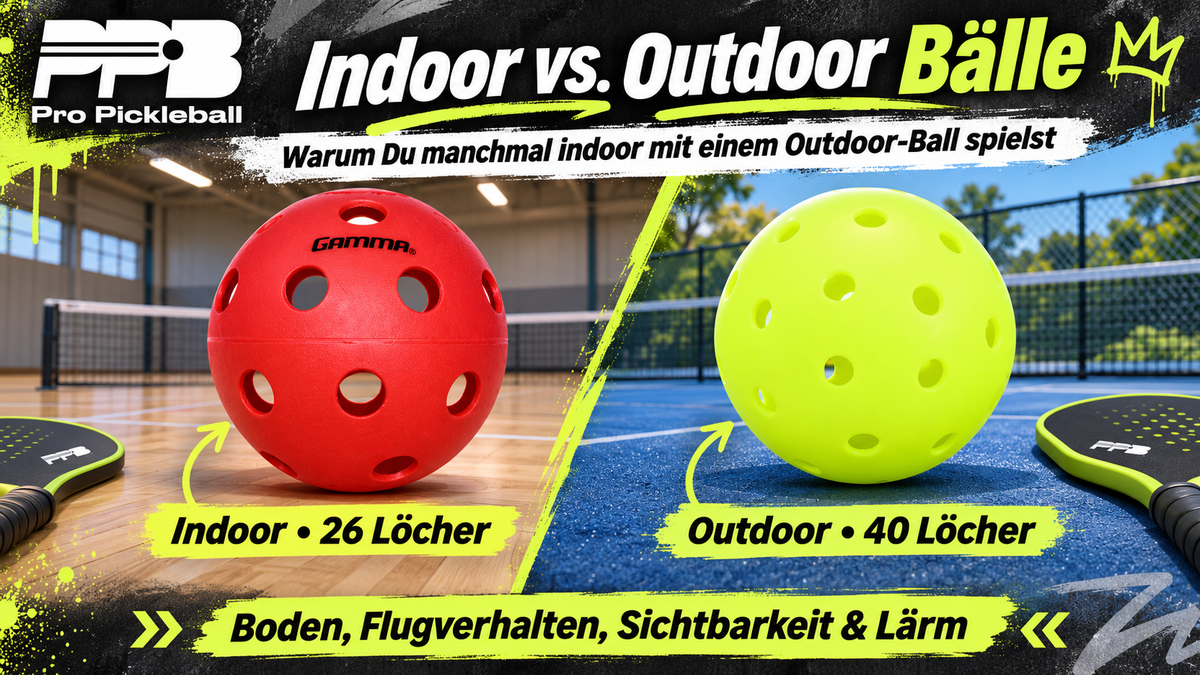
A classic indoor ball usually has 26 holes. These are relatively large and evenly distributed across the surface.
An outdoor ball, on the other hand, usually has 38 to 40 holes, which are significantly smaller.
This is no coincidence. The holes influence how air flows through and around the ball, and thus also its flight characteristics.
Outdoor balls are generally harder, slightly heavier, and fly faster. Their construction also ensures that they deviate less from the desired flight path in the wind than typical indoor balls.
This is less important with an indoor ball. There is usually no wind in a sports hall, but you play on a smooth surface. The softer construction provides a pleasant, controllable feel here.
If you look closely, you will also notice that not all outdoor balls have the same hole pattern. Some manufacturers experiment with different hole sizes or patterns to optimize flight characteristics.
The sheer number of holes therefore does not tell the whole story. Their diameter, distribution, weight, and plastic blend also influence the aerodynamics.
For everyday purposes, the difference can still be summarized well: 26 large holes are typical for indoor balls, while 40 smaller holes are typical for outdoor balls.
Here you can find our 26-hole balls and 38- to 40-hole balls in a direct comparison.
Why outdoor balls handle wind better
Anyone who has ever played pickleball in the wind knows the problem. A lob that was actually well played suddenly lands a meter away from the target. Or a ball unexpectedly hangs in the air.
With an indoor ball, it would be even more difficult.
Due to their construction, outdoor balls are generally less affected by the wind. The many smaller holes change the air resistance and the airflow around the ball. Together with the slightly higher weight, this often results in a more stable flight path.
Of course, even the best outdoor ball cannot make strong wind disappear.
Especially in competition, consistent flight characteristics are important. If the ball reacts differently than expected during a fast drive, a precise drop, or a high lob, it can make a significant difference.
Hard or soft: How the material affects the game
In addition to the holes, the material used plays at least an equally important role.
Indoor balls are usually made of a softer, more flexible plastic blend. The ball gives slightly more when it makes contact with the paddle, which often results in a softer hitting feel and a slightly slower game.
Outdoor balls are usually harder. Contact with the paddle feels more direct, and the ball often leaves the hitting surface at a higher speed.
Anyone who switches between different balls will notice this especially during fast volleys or drives.
Hardness also has its disadvantages, however. Especially at low temperatures, hard plastic balls can become brittle and develop cracks more quickly. Anyone who plays outdoors in winter probably knows this.
Indoor balls, on the other hand, can deform more under intense use and thus lose their original playing characteristics.
Therefore, with both variants, it is worth checking occasionally whether the ball is still round. A slightly deformed ball can make surprising changes in direction when it bounces.
JOOLA HC-40: The ball of the Swiss Pickleball Tour and the RTA Pickleball Tour
A well-known example of a modern outdoor ball is the JOOLA HC-40.
The name already explains its intended use: HC stands for HardCourt, and the number 40 for its 40 holes.
JOOLA developed this ball for playing on hard courts. The plastic blend and hole pattern are designed for as consistent flight characteristics as possible, a consistent bounce, and high durability.
The fact that the HC-40 has also proven itself in top-level sports is shown by its use in two major tournament series: it is the official game ball of the Swiss Pickleball Tour and is also played on the RTA Pickleball Tour, Europe's strongest pickleball tour.
This means the same ball is used in both national Swiss competitions and international European pro tournaments.
And anyone who plays tournaments regularly knows: it is worth training with the official game ball. Even small differences in hardness, speed, and bounce can be crucial during fast ball exchanges.
In our shop, you will find the JOOLA HC-40 as well as other outdoor and tournament balls.
Yellow, orange, green, or red: Why are there different ball colors?
Most pickleball balls are yellow or neon green. There is a simple reason for this: On the mostly blue, green, or dark courts, these colors are highly visible.
But not everywhere is played on such surfaces.
Especially in Swiss sports halls, you often find light, yellowish wooden floors. A yellow ball does not necessarily stand out particularly well on them. During fast ball exchanges, this can be quite distracting.
This is where red or orange indoor balls come into play.
A red pickleball offers a significantly better contrast on a yellowish parquet floor. The ball is easier to track, especially during fast shots or in unfavorable lighting conditions.
That is why red pickleball balls are practically found exclusively indoors. For the classic blue or green hard courts, however, the well-known neon colors have become the standard.
One example is the red Gamma Photon indoor ball, which is designed specifically for sports halls with light wooden floors.
The color does not change the technical playing characteristics, by the way. But it can have a significant impact on how well we perceive the ball.
Click here for our indoor balls.
The noise problem: Can pickleball also be quiet?
The typical "pop" in pickleball is hard to miss. What is part of the game for the players can quickly become disruptive for the neighbors.
Pickleball facilities are often built in residential areas, so noise generation is therefore an important issue.
Hard outdoor balls usually make a more distinctive sound when they make contact with the paddle than softer indoor balls. In addition, the paddle itself also has an influence on the sound.
In a sports hall, this is not necessarily better. The walls and ceiling can reflect the sound, which increases the noise level even further.
Quiet pickleball balls specially developed to reduce noise are now available.
An interesting example is the Selkirk Q1 Quiet Ball. It is designed to significantly reduce the typical racket sound (-34%) without greatly altering the feel of a conventional pickleball. Unlike pure training balls, the Q1 is also approved for competitive use.
There are also even quieter foam variants, such as the Gamma Librarian. These are particularly well suited for noise-sensitive environments or training, although they differ more significantly from the usual feel of the game.
Quiet balls are therefore not just a novelty. They can help make pickleball possible even where noise pollution might otherwise become a problem.
You can find all variants in our collection of quiet pickleball balls.
And what are hybrid balls?
Between the classic indoor and outdoor balls, so-called hybrid balls have now also become available.
The idea behind them is simple: a ball that works on as many different surfaces as possible.
This is particularly interesting for schools, clubs, or recreational players who sometimes play in a sports hall and sometimes on a hard court.
Hybrid balls combine the characteristics of both designs and try to find a compromise between durability, speed, and feel.
However, hybrid does not automatically mean that a ball works as well on every surface as a specialized indoor or outdoor ball.
For regular training and especially for competitions, we therefore recommend sticking to the designated game ball and the playing surface.
Anyone looking for an uncomplicated ball for different playing locations will find interesting options in our collection of hybrid balls.
Which pickleball is right for me?
Anyone who mainly plays in a classic sports hall is usually best advised to use a softer indoor ball with its typical 26 holes. On yellowish parquet, a red ball can also be a good choice.
On hard courts, whether outdoors or in a sports hall, we generally recommend an outdoor ball. Anyone preparing for tournaments should ideally train with the official tournament ball, such as the JOOLA HC-40.
If you play on different surfaces, a hybrid ball can be a practical alternative. And if noise is an issue, it is worth trying quiet balls.
In the end, the most important takeaway remains: It is not the roof that determines whether you need an indoor or outdoor ball, but above all the surface beneath your feet.
And anyone who takes a closer look at the ball during their next training session may discover that the small differences make an astonishing difference.
You can find all variants at Pro Pickleball Switzerland.